Media Zone | 2026-08-12
Cost is the only axis today, and the same number keeps showing up: what your agent knows costs more per step than the model does.
Today's signal
- Dominant story: agent context volume is the bill. A paper, an IBM post, and two conference talks all attack it independently.
- Pattern: three different fixes for one problem. Compress the store, select what ships, or hard-cap it at 2% of the window.
- Cross-source: OpenAI already shipped in Codex what today's papers propose. Production is ahead of the literature here.
- Counter-signal: Anthropic says the harness fix you shipped last quarter is now actively costing you latency and cache.
- Quiet area: no curated bookmarks for a third day, and Reddit returned nothing for a fourth. Practitioner layer is thin.
- Bookmark feed unavailable. No X session cookies at
~/.config/cere-bro/x-cookies.json, so saved posts could not be read. The AI-handle timeline and RSS stand in, and this page says so rather than implying bookmarks were reviewed.
Routing, KV cache, compression, GPU
The agent context bill, and three incompatible answers to it
- Cost optimization, and it is the day's whole story. A self-evolving agent's skill file is injected on every step forever, so its size is a recurring charge. Two results dated today attack it, and neither cites the other.
- IBM Research has the number. Against ACE (the standard loop that injects one comprehensive playbook every step), selectively delivering guidelines hits 89.3% task completion at 263K tokens per task versus 80.4% at 634K on AppWorld. Both axes improved, so the baseline context was actively harmful, not just wasteful.
- SkillZip takes the other branch: shrink the artifact instead of the delivery, via a minimum-description-length objective, and crucially with no evaluation rollouts, so rare rules survive by construction rather than by hoping a sampled task hits them.
- The gotcha nobody has tested: compression and selection are composable and nobody has run both. If combining them is not roughly multiplicative on tokens, one of the two is redundant.
Production already solved this, and the talks are more specific than the papers
- Influence optimization: OpenAI's Codex harness ships the fix the papers are proposing. Deferred tools keep the tool registry out of the context window entirely, discoverable later via tool search, so an unbounded MCP registry stops being a context tax.
- The skills manifest is hard-capped at 2% of the maximum context window, and past that the harness progressively shortens each description rather than dropping skills. That design choice, degrade fidelity but preserve discoverability, is exactly SkillZip's coverage constraint arrived at by engineering instinct.
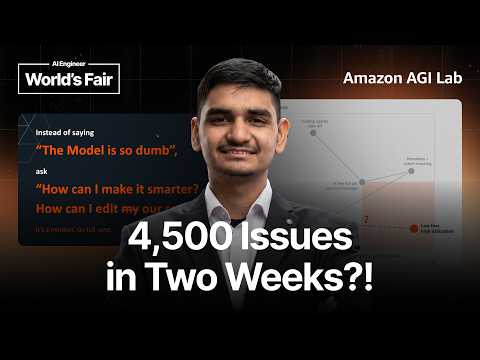
- Amazon AGI Lab gives the operational threshold, and it is the most portable number of the week: baseline context load should be 20 to 25K tokens, and if your first prompt pulls 40 to 50K your progressive disclosure is broken.
- Cost angle, stated bluntly in that talk: token budgets got bolted on after companies discovered "money is being lit on fire and it has to come from somewhere." The context-diet work is a finance response, not a research fashion.

Anthropic: your harness fix is now costing you money
- The best single idea in this week's video pile, and it is a cost claim: harnesses encode assumptions about what the model cannot do, and those assumptions go stale as models improve.
- The worked example is unusually candid. Sonnet 4.5 had "context anxiety," wrapping up work early near its window limit, so Anthropic built context resets into the harness. Opus 4.5 does not do this at all, so the fix became active harm: added latency and cache discarded incorrectly.
- Cost optimization from architecture: splitting the agent loop (brain) from tool execution (hands), originally one container, bought 60% faster time to first token at P50 and over 90% at P95, because container setup left the critical path.
- The enterprise warning worth repeating: rigid harnesses built around older models take weeks or months to migrate, which is a real liability now that release cycles are measured in weeks.

Sub-two-bit quantization gets a schedule fix, and the memory market is funding the reason
- Cost optimization at the weight level. "From Sweep to Seam" changes nothing about the quantizer and only the order blocks are processed in, revisiting already-quantized seams instead of sweeping past each once.
- The result is binary rather than incremental: at 1.58-bit ternary, a single left-to-right sweep produces blown-up perplexity on Llama-3-8B and Qwen3-8B because early error compounds with depth and is never revisited.
- Why it matters commercially this week: OLIX raised $312M at a $3.3B valuation for HBM-free inference, and Sandisk plus SK hynix published the first open High Bandwidth Flash spec. Both describe stacks with far less fast memory, the only regime where ternary weights earn their complexity.
- Open question the paper dodges: the extra passes cost calibration compute, and post-training quantization's whole appeal is being cheap. No cost number given.
Modal: inference capacity becomes RL capacity
- Cost optimization with the best leverage ratio in the pile, and worth carrying over from the 08-10 capture because nothing has answered it.
- The observation: roughly 99% of rollout-visible weights are bit-identical between consecutive optimizer steps, because Adam's per-parameter step is around the learning rate while the BF16 rounding boundary is about |w|/256. The updates are dense in FP32 master weights and too small to survive the cast.
- The consequence: ship a lossless bit-level patch instead of a checkpoint and the weight-sync link drops from about 500 GB to about 500 MB, so rollout workers can run in any region on any provider.
- Influence angle: if rollout fleets stop needing to sit inside the trainer's RDMA cluster, spare inference capacity anywhere becomes RL capacity, which reprices the whole post-training buildout.

LLMs, agents, safety
Grok Bot ships, and the interesting part is whose infrastructure it runs on
- A six-post launch cluster from xAI and Cursor handles, all amplifying agents that sign into your work accounts and return finished work.
- The actual finding came from Hugging Face's Elie Bakouch, who noticed the onboarding URL is
cursor.com/bot/onboardingand the dashboard redirect lands oncursor.com/dashboard. The Information confirmed it as a joint SpaceXAI and Cursor build. - Influence optimization, read as a warning: Bakouch is "very worried about vendor locking on this kind of apps," which is the right frame when the product's whole value is holding credentials to every tool you use.
- Timing is the counter-signal. DSAgentBench published the same day says the best agent completes 56.7% of real multi-tool workflows, and every open-source agent under 1%. Grok Bot is shipping into that.
The bugs changed shape, and two independent sources agree
- Anthropic's Boris Cherny, first-party and specific: models still produce bugs but "less off-by-ones and more about system design, ui usability, missing broader context." Some coding is solved, not all of it.
- His fix is cheap, which is why it is worth repeating: adversarial code review, triggered by a one-line prompt or
/code-reviewat an effort level. Token optimization by not spending on a bigger model. - Cross-source confirmation from production data: the 08-10 study of 3.52 million AI-authored changes in one enterprise C++ codebase found a repeatable quality profile concentrated in interface and coupling burdens, not local logic errors. Two sources, same conclusion.
- The cost sting in that study: AI-generated code raised production compute consumption 5 to 8%, larger than most published inference-efficiency wins.
Recording everything, framed as an agent-context play
- Circleback's CEO makes a context argument, not a note-taking one: as agents do more work, an agent that does not know what was said earlier today is working in isolation, so the opportunity cost of not recording is already high.
- The eval discipline is the transferable part, and it is unusually concrete, including a negative rule (a task completed during the meeting must not become an action item) and a style constraint (notes should never contain the word "discussed").
- The governance list is the sharpest founder statement of the week: agents never send email autonomously, never ship production copy, never touch data access or security, and the engineer architects while the agent builds.
- What the video omits is legal, and it is load-bearing: twelve all-party-consent states, four class actions against Otter.ai as of April 2026, and a GDPR position where consent is not an available basis in employment.

Industry and business
Europe sells hosting, not models
- Mistral shipped in-region inference plus new European infrastructure for sovereign AI, serving open models rather than only its own.
- Bakouch's read is the item: "mistral, the inference provider company of Europe." His reasoning is that Mistral's models trail the best open weights, so infrastructure wins large clients without forcing its own models on them.
- Influence optimization: this is the geographic version of the metering position, the same asset this wiki argued was the real prize in the $10B Stripe-OpenRouter talks, where the durable value was the position rather than the routing policy.
- Sovereignty is being monetized as hosting. That is a cheaper thing to sell than frontier capability and a harder thing to dislodge.
Token burn shows up on the invoice and in the earnings
- OpenAI introduced $125 Premium Seats for ChatGPT Business, five times standard, with no five-hour usage limit, explicitly because agentic AI burns more tokens. Flat-rate pricing was never going to survive agents.
- CoreWeave: revenue up 112% to $2.575B, cash burn up about the same to $5.7B, adjusted EBITDA doubled to $1.5B, and the stock rose 13% after hours anyway.
- River AI raised $1.1B (Igor Babuschkin) shipping LoRA fine-tuning and RL on open models from 35B to 1T parameters. The pitch is cost-shaped: stop renting behavior you cannot keep.
- Trajectory raised $40M at a $300M valuation led by Sequoia with NVIDIA, two months after a $115M round, selling exactly harness tooling plus open-model customization. A 2.6x step-up in eight weeks on the thesis this page has been tracking all week.
NVIDIA optimizes for speed and against its own customers
- Nemotron 3.5 Lightning matches gpt-oss-120b on the Intelligence Index with 3.6B active parameters at nearly 670 tokens per second, the fastest in its comparison. Cost optimization stated as a product position.
- Nemotron 4 is aimed at being the best open-source model in the world. The prior model's paper had 570 authors and this one will have more.
- Gary Marcus names the conflict, and it is real: a genuinely open-source NVIDIA model is good for developers and undercuts OpenAI and Anthropic, with whom NVIDIA has deals.
- Influence angle: selling shovels while also giving away the gold is coherent only if model commoditization raises total GPU demand, which is the same bet underneath the $500B compute-financing alliance.
Practitioner ground truth
- Nothing to report from Reddit for a fourth consecutive day. All eight subs, including r/LocalLLaMA, r/CUDA and r/HPC, returned zero posts passing filters. Four days of uniform silence across every sub is not a quiet week.
- The conference talks are standing in as the practitioner layer, and the Amazon AGI Lab failure checklist is the closest thing to ground truth today: babysitting agents means the setup is wrong, and "the model is dumb today" almost always means the harness changed rather than the model.
- The honest failure number from that talk: their team blew up to 400 to 500 open issues within a couple of weeks of wiring agentic issue creation into the repo.
- The distributional warning is the part managers should read: engineers shipping one or two PRs a day absorb the review burden from those shipping ten, so they never get to ship, and the inequity is self-reinforcing.